

Emergency Preparedness for Seniors: Free Printable Kit Checklist
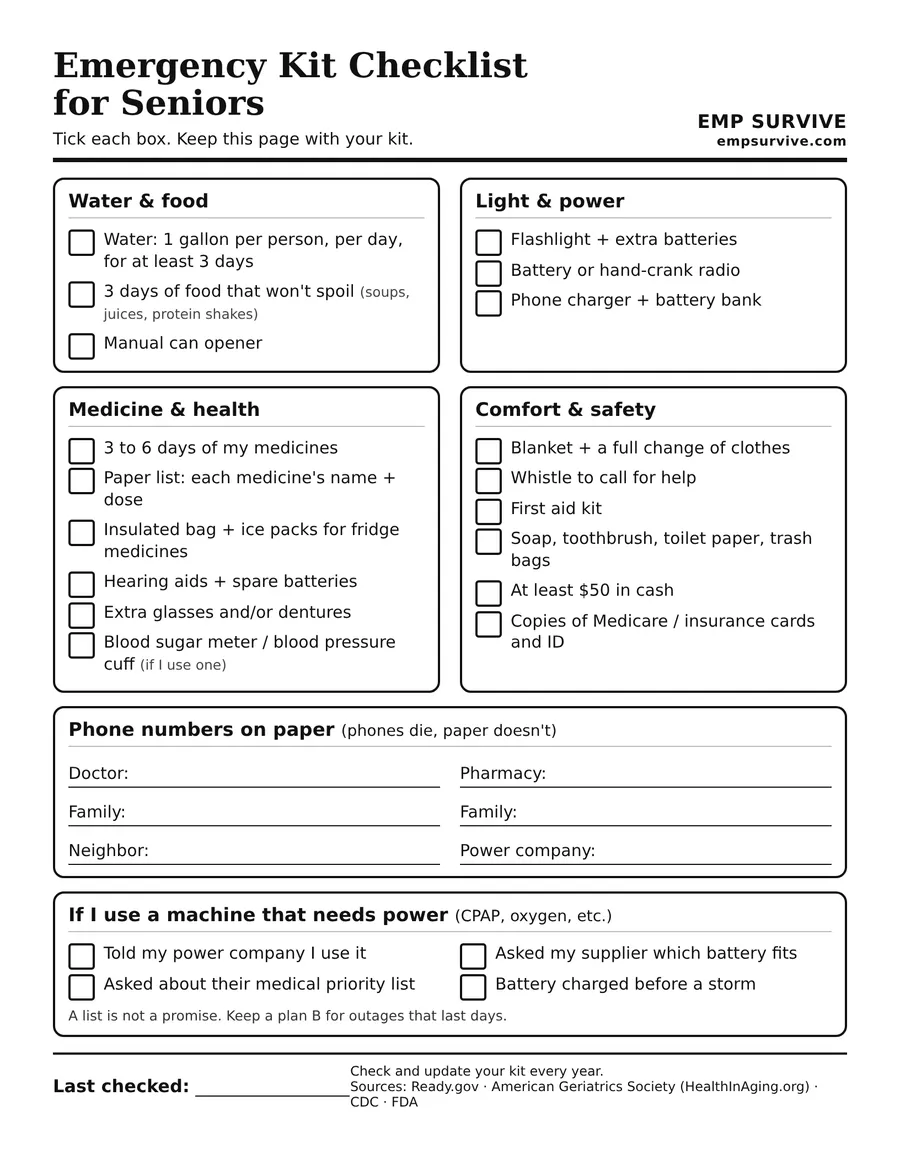
One page. Big print. No sign-up. Print it, tick the boxes, and keep it with your kit. It covers what most kit lists forget: medicines, hearing aids, glasses, and the machine that needs power.
Free · 1 page · US Letter · prints fine in black and white
What’s on the checklist?
The usual basics are there: water, food and a flashlight. Then come the boxes that matter more after 60, each on its own line so they’re hard to skip.
Water & food
- Water: 1 gallon per person, per day, for at least 3 days
- 3 days of food that won’t spoil (soups, juices, protein shakes)
- Manual can opener
Light & power
- Flashlight + extra batteries
- Battery or hand-crank radio
- Phone charger + battery bank
Medicine & health
- 3 to 6 days of my medicines
- Paper list: each medicine’s name + dose
- Insulated bag + ice packs for fridge medicines
- Hearing aids + spare batteries
- Extra glasses and/or dentures
- Blood sugar meter / blood pressure cuff (if I use one)
Comfort & safety
- Blanket + a full change of clothes
- Whistle to call for help
- First aid kit
- Soap, toothbrush, toilet paper, trash bags
- At least $50 in cash
- Copies of Medicare / insurance cards and ID
Also on the page
- Write-in lines for phone numbers: doctor, pharmacy, two family members, a neighbor, the power company
- Four boxes for anyone who uses a machine that needs power (CPAP, oxygen and the like)
- A “Last checked” line
Why does an emergency kit for an elderly parent look different?
A standard kit assumes you’ll be fine once you have water and a flashlight. But many older adults take daily medicine, wear hearing aids or glasses, or keep insulin in the fridge. Lose one of those in a storm and a short outage turns into a real problem.
The American Geriatrics Society’s tip sheet for older adults suggests a 3 to 6 day supply of medicine, an up-to-date medicine list, and an insulated bag with ice packs for anything that needs to stay cold. It also lists spare hearing aid batteries, extra glasses, a whistle and at least $50 in cash. Every one of those has its own box on our checklist.
Do you use a machine that needs power?
If you sleep with a CPAP or use oxygen at home, the CDC says to tell your utility company and ask whether it keeps a priority list for medical needs. Being on that list can help, but it doesn’t mean your power comes back first. So the FDA suggests calling your device supplier or maker to ask if your machine can run on a battery or a generator, and which one fits.
What to do: make those two calls this week, while the lights are on. Then write both numbers in the phone box on the checklist.
Why put phone numbers on paper?
Phones die. In a long outage the battery bank runs out too, and most of us don’t know a daughter’s or a doctor’s number by heart anymore. A paper list in the kit fixes that for the price of a pen.
How often should you check the kit?
Ready.gov suggests rethinking your needs every year and updating the kit. Write the date on the “Last checked” line. A birthday is an easy day to remember: swap medicines before they expire, test the flashlight, and update the phone numbers.
Want to know how much food your household needs for longer than 3 days? Our Food Storage Calculator works it out in a minute. And if you’d like a few more large-print pages for the fridge, the free Crisis Survival Guide covers the first hours of a power outage.
Want it all in one place?
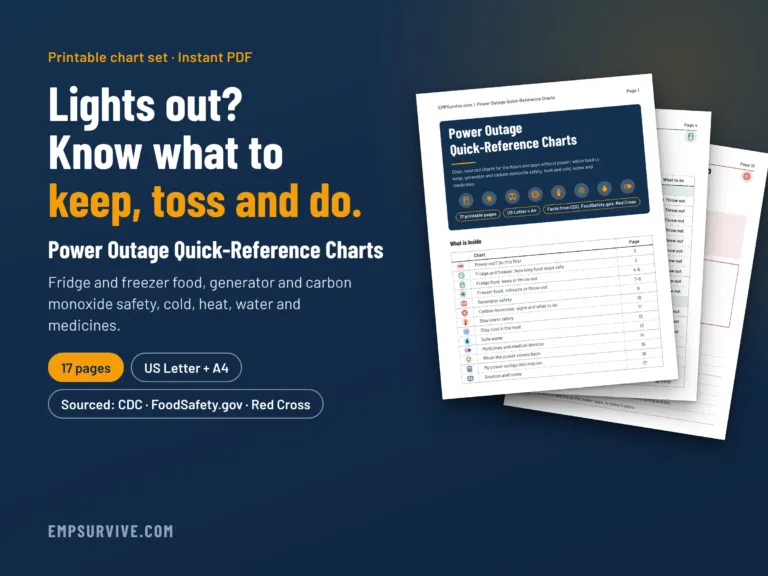
The free checklist is enough to put a kit together. If you’d also like the medicine list, the doctors’ numbers and where your papers are kept all in one binder, or the outage rules on one sheet by the fridge, these two do that job.

Questions
Is the checklist really free?
Yes. No email, no account. Print as many copies as you like, one for your kit and one for your parents.
Can I print it on A4 paper?
It’s made for US Letter. On A4, pick “Fit to page” in your print settings and it will fit fine.
How much water does one person need?
The usual guide is 1 gallon per person, per day, for at least 3 days. That’s for drinking and basic washing.
Where the facts come from
- American Geriatrics Society, HealthInAging.org: Emergency Preparedness for Older Adults
- Ready.gov: Build a Kit and Older Adults
- CDC: Prep Your Health: Power Sources
- FDA: Tips about medical devices and natural disasters
Print it today, while the printer still has power.
Print the checklist