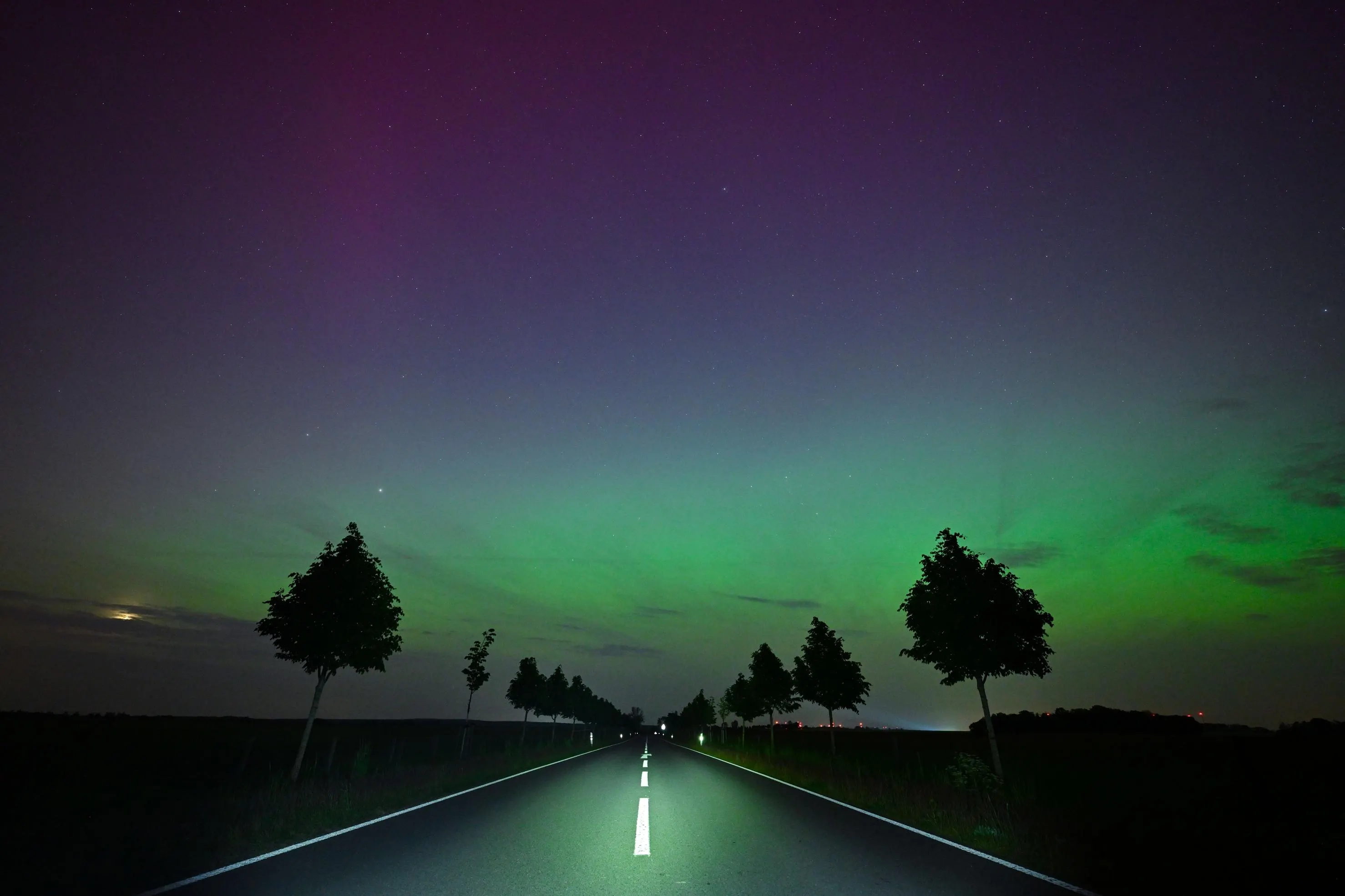
According to NOAA and reported by Forbes, a coronal mass ejection (CME) is expected to strike Earth's magnetosphere on Monday, June 8, through Tuesday, June 9, 2026, making the northern lights visible from up to 20 northern U.S. states.
This is a low-severity event from an infrastructure standpoint. CME activity exists on a spectrum—most pass without degrading power systems, communications, or GPS. Strong geomagnetic storms (G4 or G5 on NOAA's 5-point scale) pose real grid risk; this alert does not indicate that classification yet. The visible aurora is a symptom of magnetospheric disturbance, not a measure of infrastructure impact.
What matters: CME strikes do occasionally trigger localized transformer stress, particularly on older grid hardware in high northern latitudes. Telecommunications and aviation GPS can experience brief disruptions during stronger events. Satellites in low Earth orbit face increased atmospheric drag.
For infrastructure operators and grid-aware readers, the key intelligence is establishing what NOAA's official storm classification actually is (G1, G2, G3, G4, or G5). The aurora visibility doesn't automatically map to risk level. A strong visual display can occur during moderate geomagnetic activity.
Historically, the 1859 Carrington Event—a G5-class CME—caused widespread telegraph failures. The 1989 Quebec blackout resulted from a G4-class storm. We've had near-misses since: the 2012 CME passed through Earth's orbit but missed the planet by days. The grid has since hardened somewhat, but transformer vulnerability remains, particularly for units manufactured before 2000 and in regions with aging infrastructure.
The real preparedness value here is not Monday night's light show—it's using this as a baseline reminder to verify your critical system dependencies (backup power, water, communications alternatives) are current and tested. CMEs are predictable when detected; solar variability is not. Track NOAA Space Weather Prediction Center updates through the event window.
