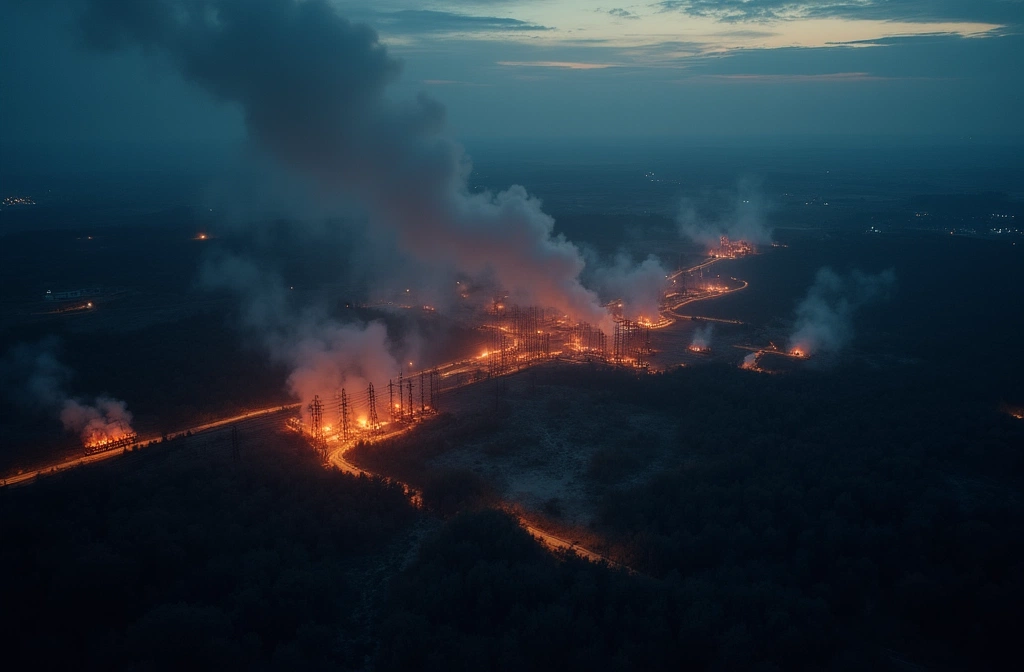
According to UNITED24 Media, satellite imagery has documented visible darkening across Crimea consistent with widespread power grid degradation resulting from drone targeting operations. The report uses geospatial evidence—rather than on-ground claims alone—to confirm that critical infrastructure in the region is experiencing active damage.
This matters because power grid resilience under sustained drone assault is no longer theoretical. The Crimea case demonstrates that modern aerial platforms can inflict measurable, observable damage to energy distribution systems across a geographic area. Satellite confirmation of outages—visible as reduced nighttime illumination—removes ambiguity and establishes a documented baseline for how grid systems respond to repeated strikes.
For preparedness analysts, the signal is clear: distributed, resilient power infrastructure is becoming a strategic necessity, not a luxury. Single-point failures in centralized generation or transmission now face a documented threat vector. Regions dependent on fragile grid topology or aging infrastructure may experience cascading failures that persist longer than tactical repair cycles can address.
The intensity and persistence of these operations also underscores a shift in conflict methodology. Rather than one-off strikes, the pattern suggests sustained campaigns designed to degrade rather than destroy—forcing populations into chronic scarcity conditions. This operational model has real-world implications for how civilian populations experience extended outages: not measured in hours, but in weeks or months of rolling deficits.
What to watch: Monitor whether drone operations expand geographic footprint or shift targeting to interconnection points between regional grids. Escalation indicators include simultaneous strikes on multiple substations or transmission nodes—a sign of coordinated, larger-scale campaigns. Track repair timelines reported by local authorities; extended restoration windows suggest either targeting precision improving or infrastructure degradation accelerating. Grid operators in comparable regions should model response protocols assuming multi-week outage scenarios rather than standard 48-72 hour recovery windows.
