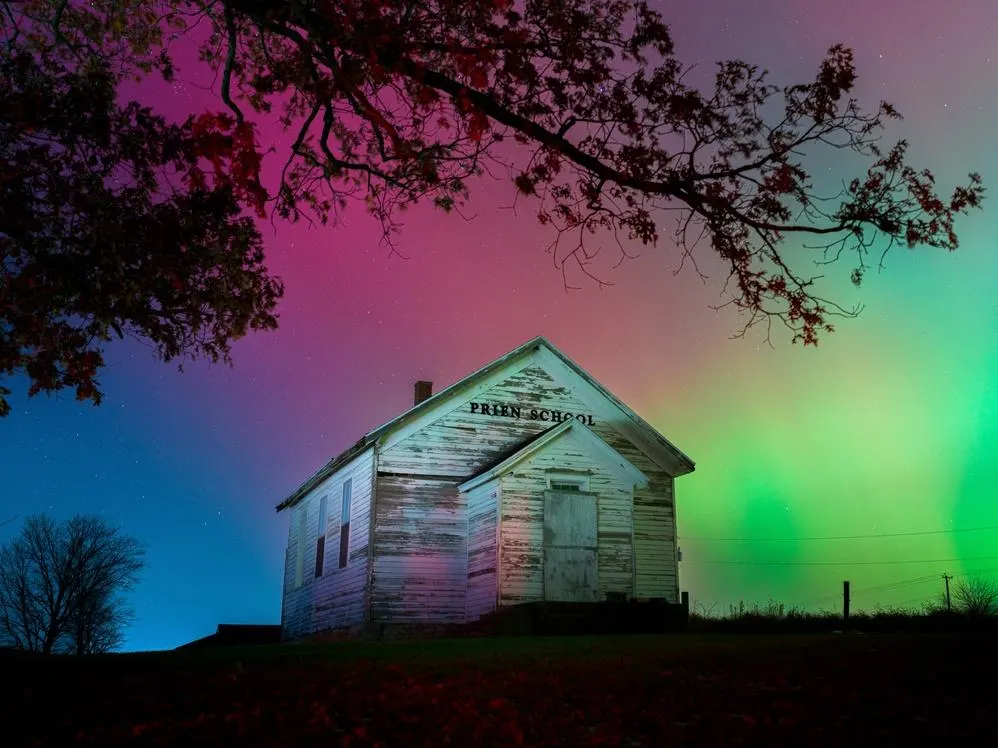
NOAA has predicted geomagnetic storms to arrive between Friday and Sunday, with a G2-class event expected in the early hours of Saturday morning. The storm is being driven by multiple coronal mass ejections—eruptions of plasma and magnetic fields from the sun's outer atmosphere. Saturday evening may provide visibility of the Northern Lights across multiple northern U.S. states, with NOAA issuing a Kp index forecast of 4.6.
G2 storms are moderate-level events on the 5-point geomagnetic storm scale (G1–G5). At this classification, impacts are typically localized: some degradation of high-frequency radio communications, potential minor effects on power grid operations in high-latitude regions, and occasional satellite orientation issues. This is not a grid-threatening event.
However, the occurrence of multiple coronal mass ejections in sequence warrants monitoring. Solar activity follows predictable cycles, but when CMEs arrive in clusters, there is a nonzero risk of stronger follow-on events. The three-day window (Friday–Sunday) means sustained geomagnetic activity rather than a single spike.
For critical infrastructure operators—particularly those managing power distribution, long-distance communications, or GPS-dependent systems in northern latitudes—this is a signal to confirm monitoring protocols are active and that staff are alert to anomalies. For most readers, this event poses no immediate operational risk.
What matters most is what happens next. Watch whether additional CMEs are detected in the coming days and whether NOAA escalates the forecast to G3 or higher. Real-time space weather data is available via NOAA's Space Weather Prediction Center. For those in aurora-visible zones, Saturday night offers a rare clear signal that Earth's magnetosphere is active—a useful reminder that solar variability is continuous and preparedness for larger events remains warranted.
