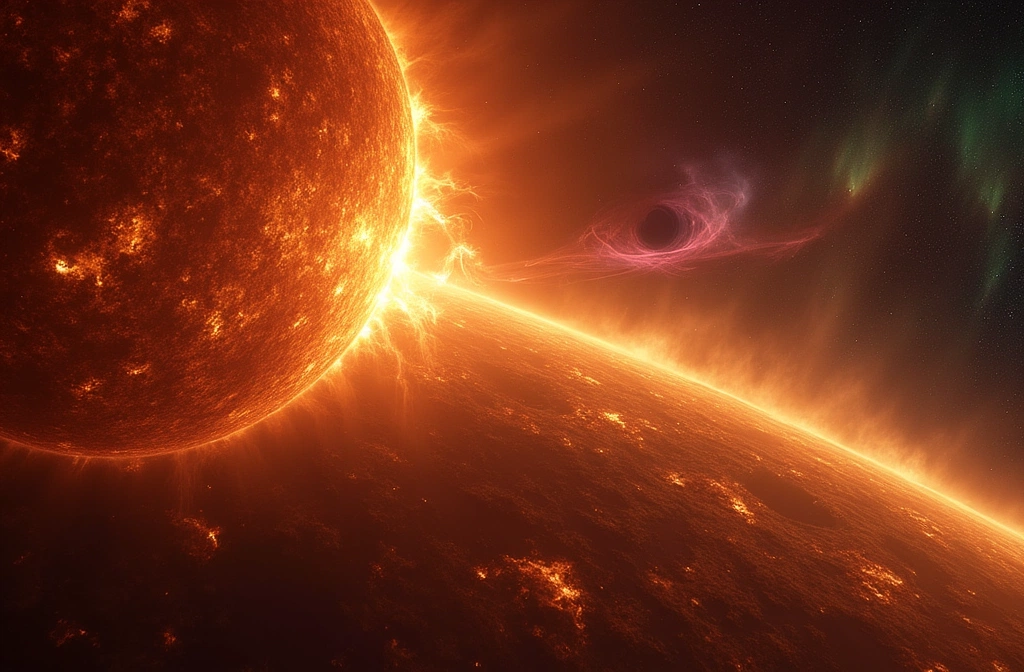
A large coronal hole is now geoeffective—meaning it's oriented to send solar wind directly toward Earth. According to EarthSky reporting on NOAA's GOES-19 satellite imagery (SUVI 195 angstrom data), the fast solar wind stream from this coronal hole is anticipated to reach Earth by May 15, potentially triggering G2 (moderate) geomagnetic storm conditions.
Coronal holes are regions of open magnetic field lines on the Sun's surface where solar wind escapes at higher velocities. When these holes rotate into Earth-facing positions, the resulting high-speed plasma streams can compress Earth's magnetosphere, destabilizing it and triggering auroras at high latitudes. At G2 levels, impacts remain localized to auroral zones and typically don't disrupt critical infrastructure, though operators of power grids and satellite systems monitor these events closely.
The distinction matters: G2 is moderate. It's not a G4 or G5 extreme event. However, it merits attention because coronal holes often precede larger solar activity, and back-to-back geomagnetic storms—even moderate ones—can stress transformer aging and degrade GPS/communications accuracy over time.
For grid operators and satellite fleet managers, G2 events are within normal operational tolerance but require active monitoring. For general infrastructure and consumer systems, impacts are usually negligible. The real signal here is what happens next: whether this coronal hole produces secondary ejecta, or whether larger active regions rotate into view over the coming days.
The timing is tight—first arrival expected within 24 hours from report timestamp—but the window for preparation actions is narrow. Ground stations and space weather centers are already tracking this; no public alert surge has been issued yet, suggesting confidence that this remains a regional aurora event rather than a widespread threat.
Watch for NOAA's Kp index updates on May 15. If the arrival produces sustained Kp 6+ values, aurora activity will extend further south than normal. If secondary coronal mass ejections emerge from nearby active regions over the next 48 hours, escalation risk increases substantially.
