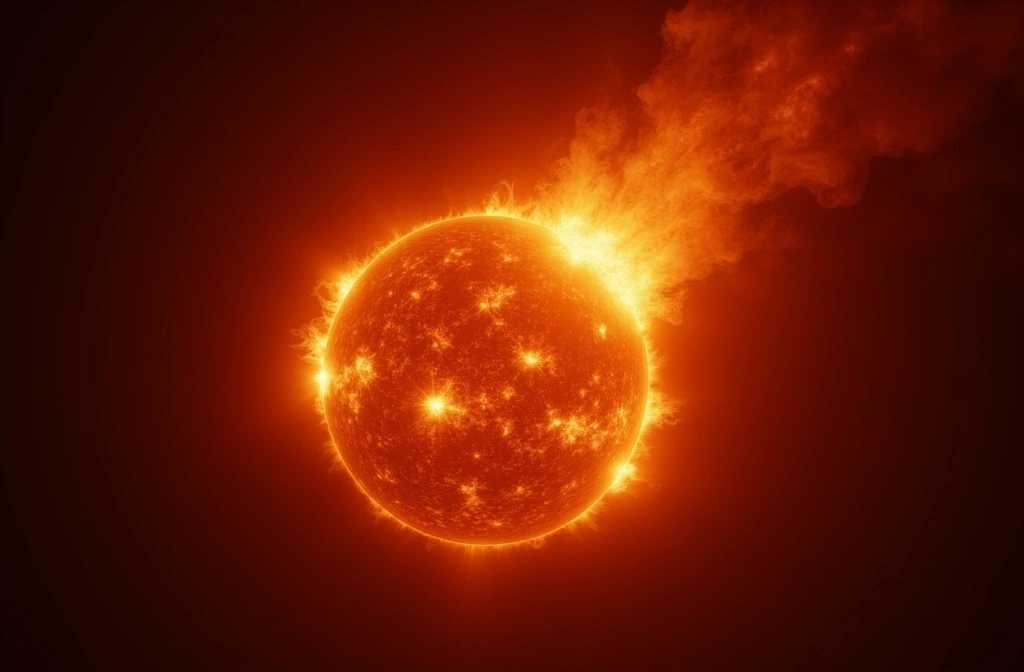
Sunspot region AR4464 produced an M-class solar flare over the past 24 hours before rotating to the sun's far side, according to NOAA data cited by EarthSky. The flare was significant enough to warrant attention—M-class events sit one tier below X-class (the most powerful)—yet Earth's magnetic response has been benign. The Kp index, the standard measure of geomagnetic disturbance, sits just above level 1, indicating no active storm conditions.
Why this matters: M-class flares can trigger geomagnetic storms, power grid stress, and HF radio blackouts, particularly when accompanied by coronal mass ejections (CMEs). The fact that AR4464 is now on the far side of the sun removes immediate threat to Earth—solar wind and particles travel roughly 8–12 minutes from sun to magnetosphere, and a far-side flare poses no direct impact. However, the activity itself is the relevant signal: new sunspot regions firing significant flares suggests the current solar cycle is entering a more active phase.
What to watch: Sunspot activity tends to cluster. If additional active regions emerge on the Earth-facing hemisphere and produce M or X-class flares, geomagnetic storm risk escalates sharply. NOAA's Space Weather Prediction Center and EarthSky provide real-time Kp index tracking—both are free and reliable reference points. Grid operators and utility companies monitor this data continuously; a sustained uptick in flare frequency and magnitude could trigger precautionary load-shedding or equipment de-energization on vulnerable circuits.
This is not a crisis alert. Current conditions pose no immediate risk to communications, navigation, or power infrastructure. But it is a reminder that solar cycles are not linear, and the quiet months can shift rapidly. For infrastructure-dependent operations and preparedness-minded readers, now is the time to verify that monitoring systems are in place and baseline data is documented—not when a G3 or G4 storm is already underway.
