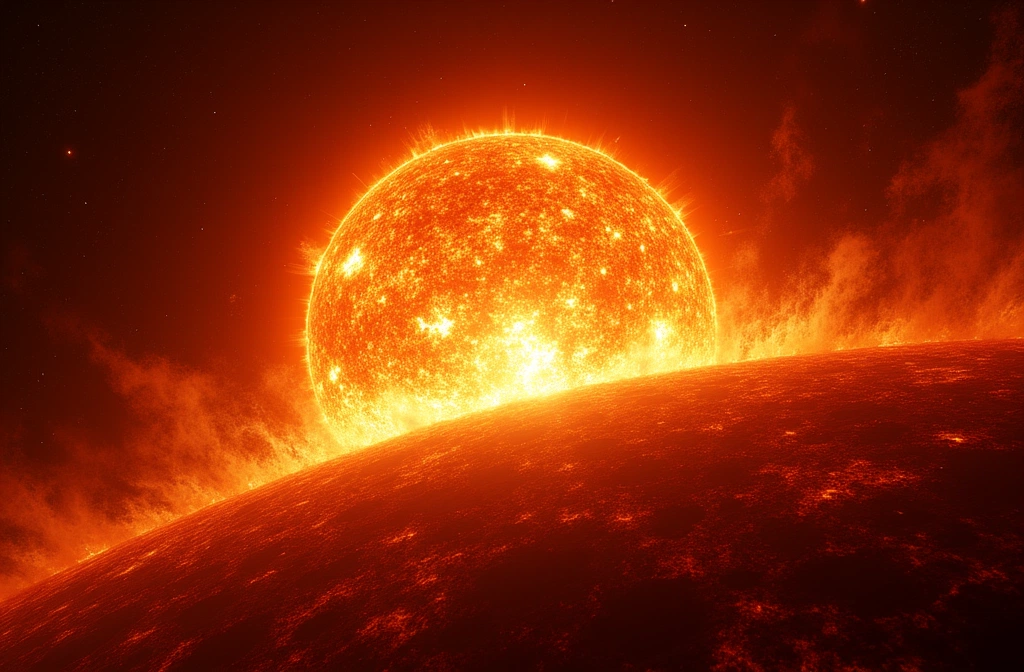
On June 3, 2026 at 7 UTC, active region AR4455 in the northwest produced an M7.7 flare, documented by NOAA's GOES-19 SUVI instrument. According to EarthSky reporting on June 4 sun news, this event could trigger additional enhanced geomagnetic activity layered atop effects from a lingering cannibal coronal mass ejection (CME)—a phenomenon where a faster-moving CME overtakes a slower one, compounding the plasma impact on Earth's magnetosphere.
Why this matters: Stacked geomagnetic events create cumulative stress on power grids, transformer networks, and long-distance communications infrastructure. While a single M7.7 flare typically correlates with G3 or moderate G4 geomagnetic storm potential, a cannibal CME scenario may extend duration and intensity of magnetospheric disturbance. Utilities with aging or legacy infrastructure—particularly in high-latitude regions and along east-west transmission corridors—face elevated risk of voltage regulation failures and protective relay misoperation.
Satellite operations, GPS precision, and HF radio propagation may also experience disruption during peak activity windows. Airlines, financial networks, and emergency services dependent on these systems should maintain contingency protocols.
Critical watch indicator: Monitor NOAA's Space Weather Prediction Center (SWPC) for real-time Kp and G-scale indices. If sustained Kp reaches 7 or higher (G3+), or if a second CME impact is confirmed and timed to overlap current disturbance, the compounding effect could stress grid operators beyond typical response thresholds. EarthSky's continued reporting suggests this remains an evolving threat—no fixed timeline has been publicly confirmed, but heightened vigilance through June 5 is warranted.
For grid-dependent operations and critical infrastructure managers: Verify backup power status, review load-shedding protocols, and ensure 24/7 monitoring capability for the next 48 hours. This is a measured, observable risk—not an outlier event, but one that demands active situational awareness.
