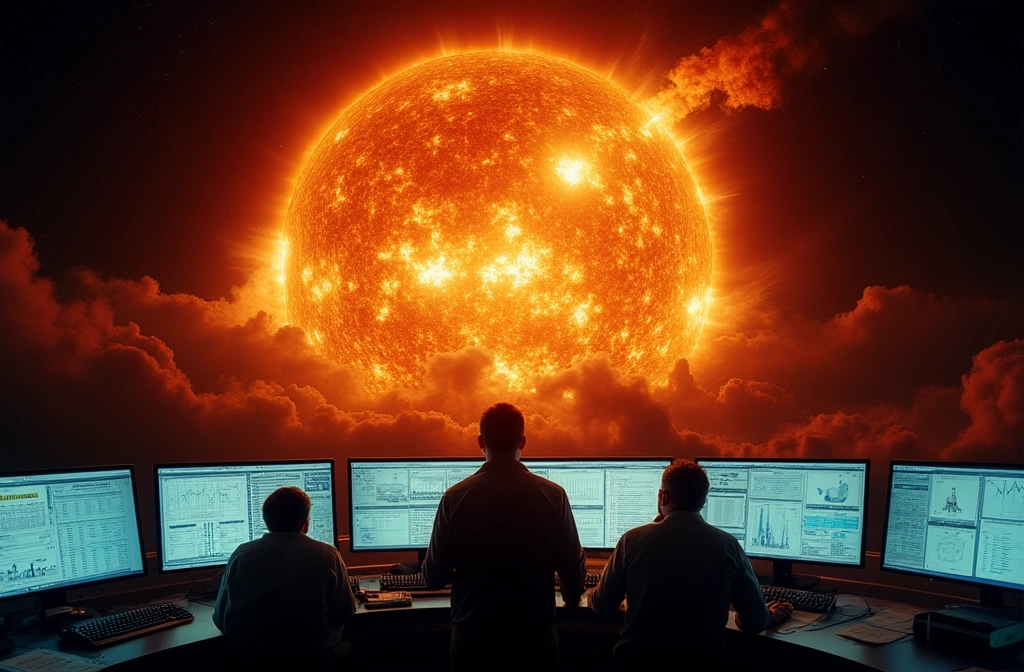
On June 30, 2026, the Sun emitted a strong solar flare, according to NASA's Solar Dynamics Observatory, which continuously monitors solar activity. The flare peaked at 4:50 p.m. ET. NASA's observation confirms the event occurred, but the agency has not yet released detailed classification, energy metrics, or downstream impact forecasts in publicly available statements.
What matters: Strong solar flares can trigger geomagnetic storms when accompanied by coronal mass ejections (CMEs) directed toward Earth. These storms affect high-voltage transformers, GPS signals, and HF radio propagation — critical infrastructure dependencies that span power grids, financial networks, and emergency communications. The lag between flare detection and geomagnetic impact typically ranges from 18 to 96 hours, depending on solar wind conditions.
Current status: This event is classified as emerging because:
- NASA has confirmed the flare but not provided full technical classification (X-class magnitude, associated CME vector, or Earth-directed probability).
- NOAA's Space Weather Prediction Center has not issued an official geomagnetic storm watch or warning as of the last update.
- No grid operator or utility has issued infrastructure alerts.
What to watch next: Monitor NOAA's Space Weather Prediction Center website for G-scale geomagnetic storm watches (G1 through G5). A G3 or higher watch would indicate meaningful risk to power distribution, long-distance communications, and satellite operations. Track real-time solar wind speed and Bz (magnetic field southward component) data — rapid increases suggest a CME arrival is imminent. Check your regional utility's website for any unplanned outage notices on June 30–July 2.
Historical note: The May 2024 geomagnetic storm (G4-level) caused visible aurora at unusual latitudes and disrupted some precision agriculture GPS systems but did not trigger widespread grid failures. That event demonstrated that modern grid protections, while imperfect, have prevented worst-case cascades. This flare does not yet indicate equivalent risk, but continued solar monitoring remains essential.
