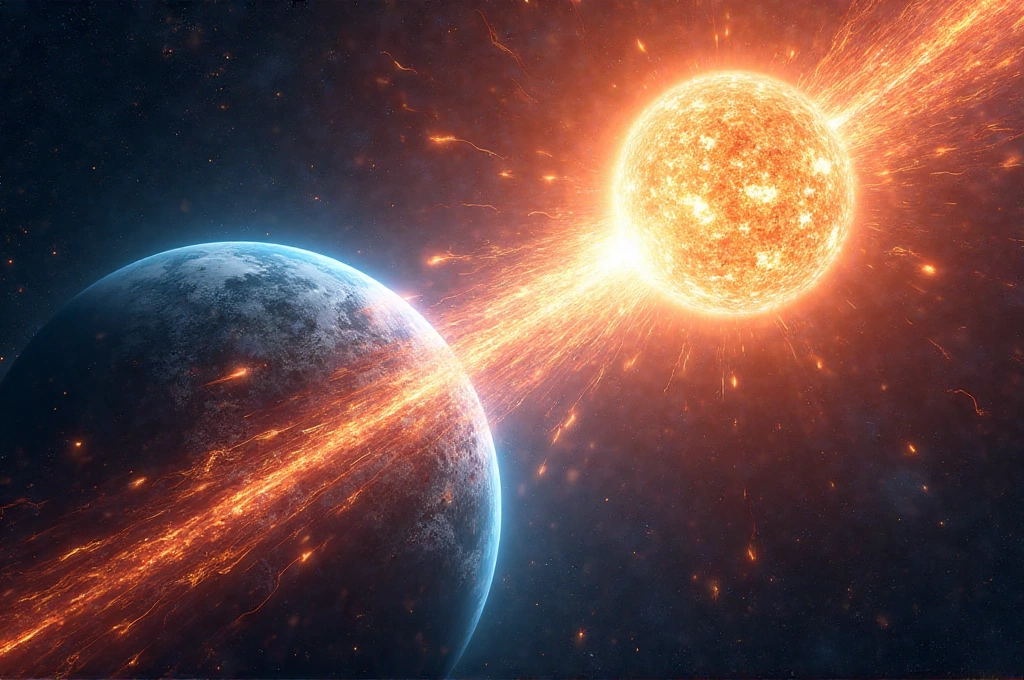
For decades, the scientific consensus held that Earth's polar geomagnetic response would plateau as solar storms intensified—a reassuring upper bound on worst-case scenarios. That consensus just cracked.
According to a NASA-led analysis published in Nature in July 2026, the apparent saturation point was probably not a real physical limit at all, but rather an artifact of measurement uncertainty. Once the uncertainty was corrected, the response remained linear—meaning it keeps rising as storm intensity rises.
The implications are direct: extreme solar storms could produce geomagnetic effects roughly twice as severe as models based on the old ceiling would have predicted.
Why this matters: Infrastructure planners, grid operators, and communications networks have relied on worst-case scenarios anchored to that saturation assumption. Transformers, long-distance power lines, and satellite systems are hardened or redundancy-planned around threat models that may now underestimate the actual threat envelope by a factor of two. A Carrington-class event or stronger hitting in an unfavorable geometry could induce ground-induced currents and ionospheric disturbances well beyond what many systems were designed to withstand.
This is not prediction—it's recalibration of the threat model itself.
What to watch: The solar cycle is currently in its ascending phase toward maximum, expected around 2029-2030. Over the next 3-4 years, watch for: (1) how rapidly NASA and NOAA incorporate this finding into operational space weather forecasting; (2) whether utilities commission new transformer vulnerability assessments based on the revised threat envelope; (3) any policy or infrastructure hardening responses from grid operators or national security agencies. These signals will indicate whether this finding is being treated as a serious revision or filed away as an academic update.
