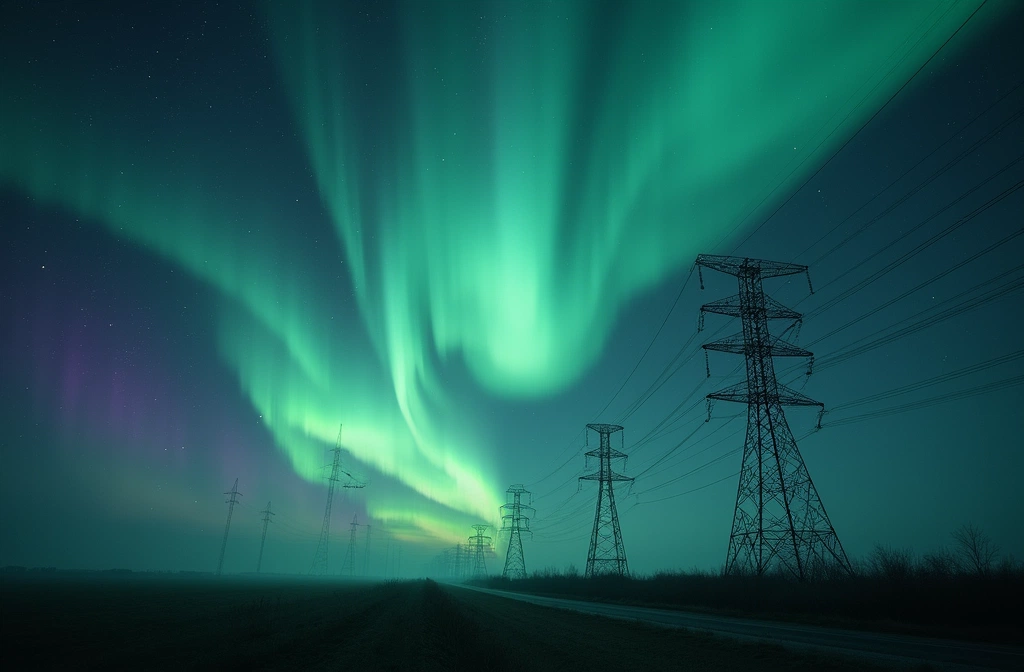
Two coronal mass ejections are in play. According to reporting, a CME that departed the sun on July 24 is delivering geomagnetic storm conditions classified as G1-G2 today. More significantly, NOAA has issued watches for a second, more powerful wave expected to arrive July 29-31. The mechanism: a 'cannibal CME'—solar material from multiple ejections merging and intensifying as it crosses interplanetary space.
The forecast window matters. NOAA's watch for G2-G3 conditions could extend aurora visibility across the entire northern United States. That's a credible indicator that geomagnetic disturbance is climbing the Kp scale. Tonight's display hinges on the Bz component—the north-south orientation of the interplanetary magnetic field. Southward Bz = energy transfer into Earth's magnetosphere. Northward Bz = energy deflection. The distinction determines whether this remains a visual event or begins stressing power grid and communications systems.
For grid operators and network infrastructure teams, back-to-back storm waves create cumulative stress. G2-G3 conditions alone are typically survivable by modern hardened systems. But repeated exposure—especially if the incoming wave validates NOAA's forecast—tests reactive capacity, transformer cooling cycles, and voltage regulation margins. Long-duration events compound risk far more than peak intensity alone.
This is not a G4 or G5 scenario. There is no evidence of an imminent Carrington-class event. What we're tracking is a legitimate infrastructure test at a mid-range severity level, arriving during summer grid demand peaks when margin is tightest.
WATCH FOR: Whether the July 29-31 window validates NOAA's G2-G3 watch, and whether Bz conditions remain southward long enough to sustain magnetospheric coupling. A sustained southward Bz exceeding -10 nT for 6+ hours during a G3 event is the threshold where minor transformer stress becomes measurable across regional operators.
