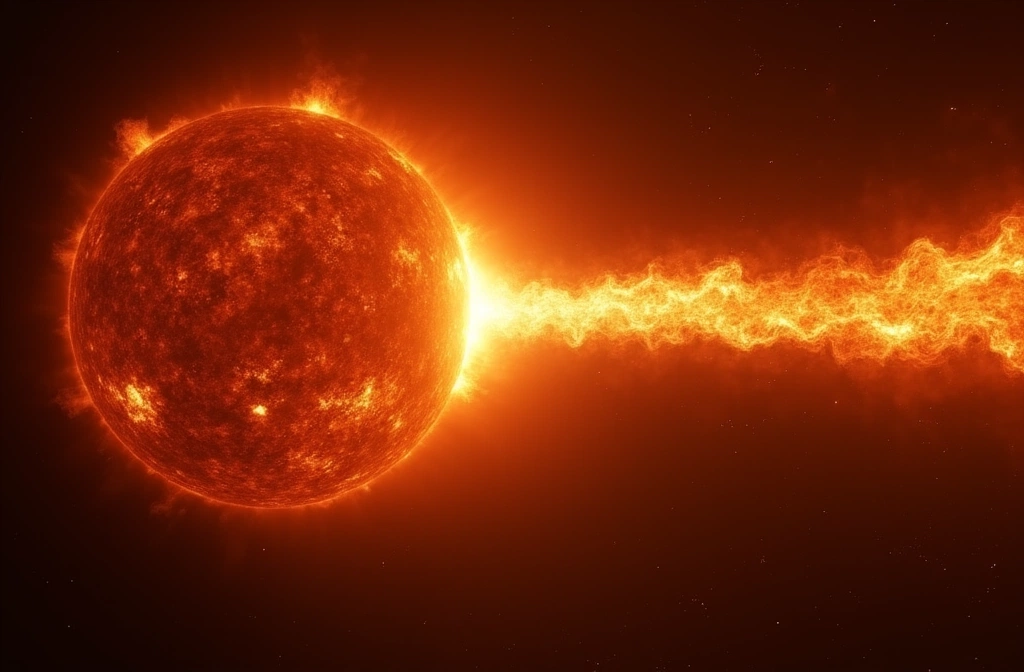
On June 17, NOAA's GOES satellite documented a notable eruption of solar material across the sun's southwest horizon. Separately, a coronal mass ejection (CME) ejected from the sun on June 12 remains in transit toward Earth and could produce a glancing impact on our magnetosphere.
According to the latest forecasting data, this incoming burst of solar material may disturb Earth's magnetic field. However, NOAA forecasters are not currently expecting geomagnetic storming from this event—a meaningful signal that the threat level remains contained.
Why this matters: Solar eruptions and CMEs are routine solar phenomena, but they carry real infrastructure implications when they arrive. Even "glancing blow" impacts can induce ground currents in long-distance power lines, stress transformer insulation, and degrade high-frequency radio propagation. Satellites in geostationary orbit and low Earth orbit can experience surface charging and radiation dose increases. For critical infrastructure operators and communicators relying on HF, VHF, or satellite uplinks, solar activity creates measurable risk.
The distinction between a direct hit and a glancing blow is significant: a direct impact could produce K-index values (geomagnetic disturbance scale) in the G2–G3 range; a glancing blow typically produces G1 or sub-G1 effects—inconvenient, not catastrophic.
What to watch: Monitor NOAA Space Weather Prediction Center (SWPC) alerts over the next 48–72 hours as the June 12 CME arrival window closes. Track whether actual magnetometer readings (Kp index) match or exceed current forecasts. A departure from "no storming expected" to observed G1+ activity would signal forecast model uncertainty and warrant heightened infrastructure vigilance. Also note whether follow-on solar activity produces additional CMEs or sustained M-class or X-class flares, which could alter the threat picture.
