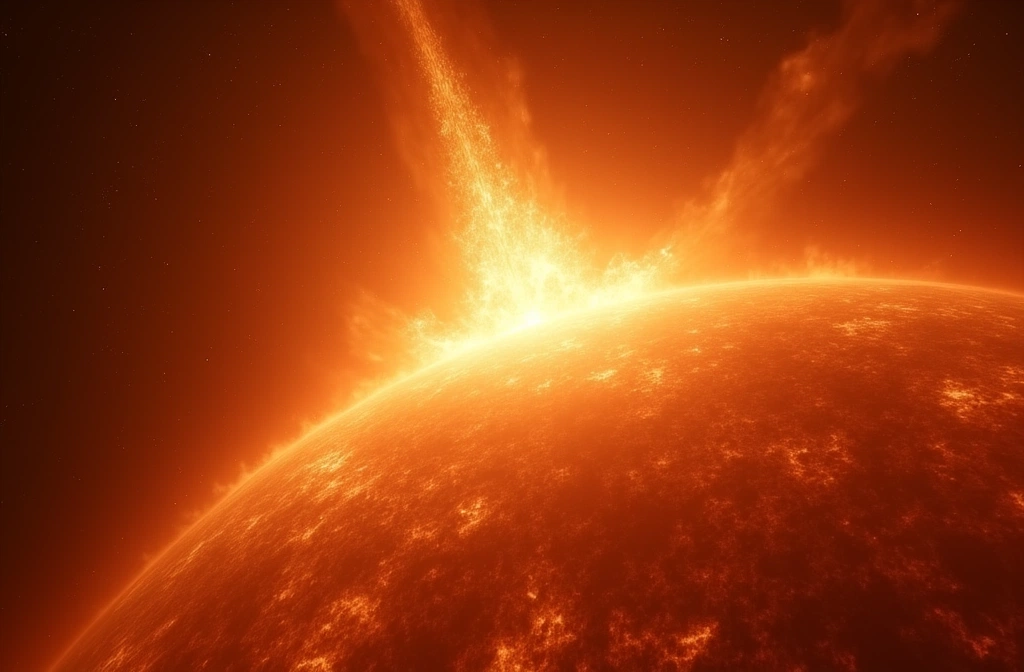
According to ScienceBlog.com, the Sun has launched a coronal mass ejection (CME) consisting of roughly a trillion kilograms of charged plasma. The fastest plasma clouds associated with such events can traverse the 150 million kilometers separating Earth from the Sun in under 18 hours—a speed that leaves minimal reaction time once detection occurs.
This matters because coronal mass ejections pose documented risks to power grids, satellite communications, and GPS-dependent systems. A direct hit from a severe CME could induce geomagnetically induced currents (GICs) in long transmission lines, potentially triggering cascading blackouts. Satellites and their operators monitor solar activity specifically because of this threat profile.
Current status: The event is classified as low severity and emerging, with only two reporting sources detected as of July 12, 2026. No official government alert (NOAA, NASA) has been cited in available signals. This does not mean the threat is negligible—it means the event is still developing and baseline assessment remains preliminary.
The distinction matters. Low severity does not mean zero severity. A CME's impact depends on several factors: intensity, arrival timing, and Earth's magnetospheric conditions at impact. Even a moderate event can stress grid infrastructure during peak demand hours or compound existing operational strain.
For readers managing critical infrastructure or dependent systems, this is a watch-level alert. For households, the probability of immediate cascading failure remains low under current severity classification, but the physics behind CME propagation times means decision windows are compressed—once confirmation arrives, response time collapses.
Monitor NOAA Space Weather Prediction Center and NASA's STEREO spacecraft for updated trajectory data and severity estimates. If classification shifts from low to moderate or high, the preparedness posture changes substantially. Until then, this is intelligence for tracking, not yet for emergency action.
