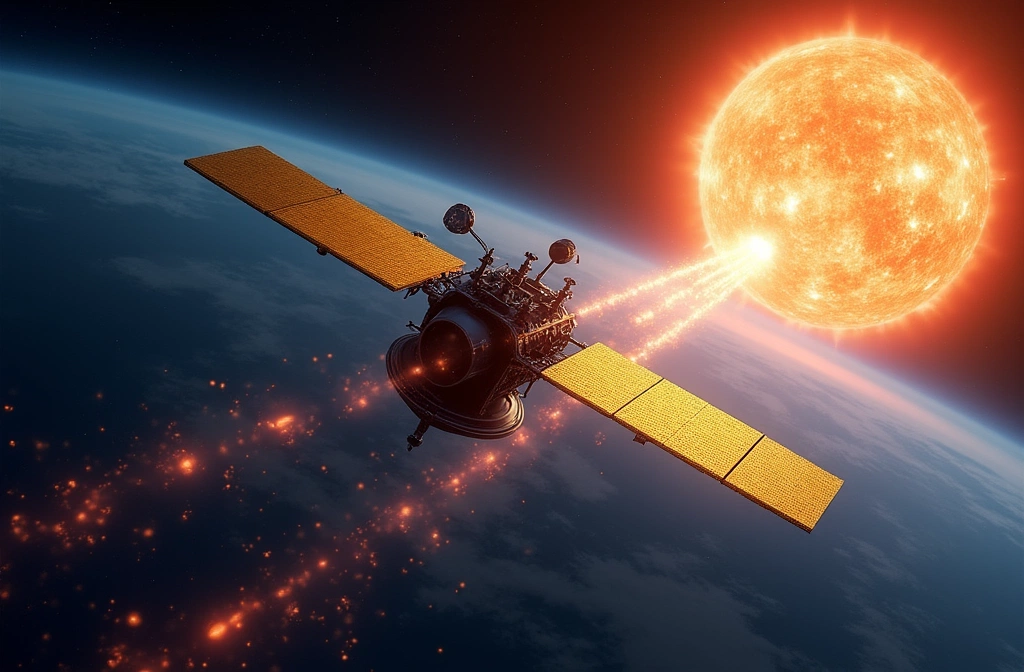
According to reporting on KASA's announcement at the COSPAR 2026 assembly in Florence, South Korea is planning its first dedicated heliospheric spacecraft with a planned cislunar launch in 2031. The mission appears designed to anchor a coordinated multi-point observation network alongside existing and planned systems from ESA (Vigil) and NASA (IMAP).
The significance here is geometric, not dramatic. Current space weather forecasting relies heavily on L1 positioning—a single vantage point roughly one million miles sunward of Earth. Multiple observation points at L1, L4, and L5 positions create redundancy and triangulation, allowing forecasters to detect solar wind structure, coronal mass ejection geometry, and particle acceleration zones with hours more warning than today's single-satellite model permits.
For grid operators, satellite operators, and communications networks dependent on solar forecasting accuracy, this matters. A 12-24 hour warning advantage on a major solar event translates directly to load-shedding preparation, transformer protection protocols, and contingency activation. South Korea's contribution suggests the international forecasting community recognizes that current warning architecture carries single-point-of-failure risk.
The 2031 timeline is firm according to the source. That's five years for mission development, payload integration, and launch readiness—standard pace for government space agencies, not accelerated. No indication of budget, technical challenges, or partnership agreements has emerged from available reporting.
What matters to track: whether ESA's Vigil and NASA's IMAP missions proceed on schedule (both central to the cited network architecture), and whether additional national space agencies signal similar initiatives. A genuine L1+L4+L5 constellation requires at least two additional platforms beyond what's currently funded. If momentum stalls at two satellites, forecasters gain marginal improvement over current capability. If the network achieves full constellation, the capability jump becomes operationally significant for critical infrastructure sectors. Watch for budget commitments and partnership announcements from other space agencies in the next 12-18 months.
