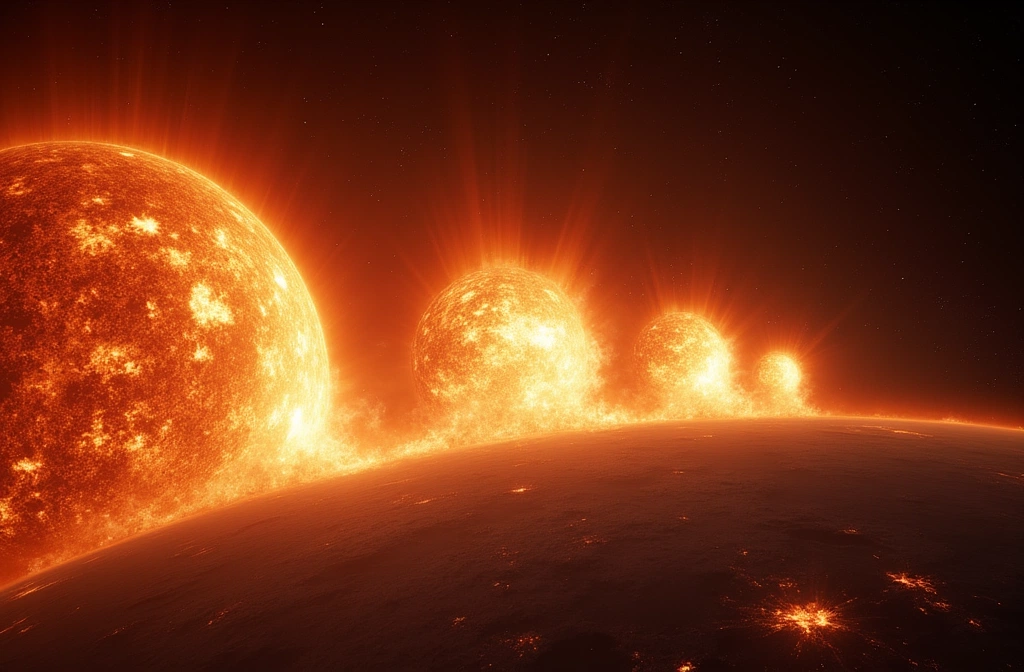
Between June 3-6, 2026, the Sun erupted with three major solar flares in rapid succession, according to reporting from Space.com and CBS News. The flares have already caused radio blackouts across Earth—a confirmed near-term impact on HF communications, aviation, and maritime systems that depend on ionospheric propagation.
Why this matters: Solar flares and their associated coronal mass ejections (CMEs) can trigger geomagnetic storms. A significant storm compresses Earth's magnetosphere, inducing currents in long conductive systems—power grids, transformer networks, pipelines, and communications cables. Even moderate storms (G2-G3 level) have historically stressed grid operations; severe events (G4-G5) carry documented risk of transformer damage and cascading outages.
The current window is uncertain. Space.com and CBS News both report that a geomagnetic storm "may" develop as solar particle activity reaches Earth, and northern lights are expected to be visible across parts of the U.S. as a visual indicator of heightened magnetospheric activity. However, no sources in the signals provided specify exact timing, intensity, or confirmed geomagnetic storm classification.
What to monitor: Grid operators and utility companies will be tracking the solar wind data and magnetosphere indices. NOAA's Space Weather Prediction Center publishes real-time geomagnetic K-index and Kp forecasts—these are the standard metrics for measuring storm severity. If forecasts escalate beyond G2, that signals elevated transformer stress and potential voltage regulation issues on interconnected grids, particularly in high-latitude regions.
For preparedness: Keep battery backups charged and fuel reserves topped off if you rely on backup power. Verify that critical systems (medical devices, communications, heating/cooling) have 72-hour autonomy. This event is a live reminder that solar activity is a documented infrastructure risk—not hypothetical.
