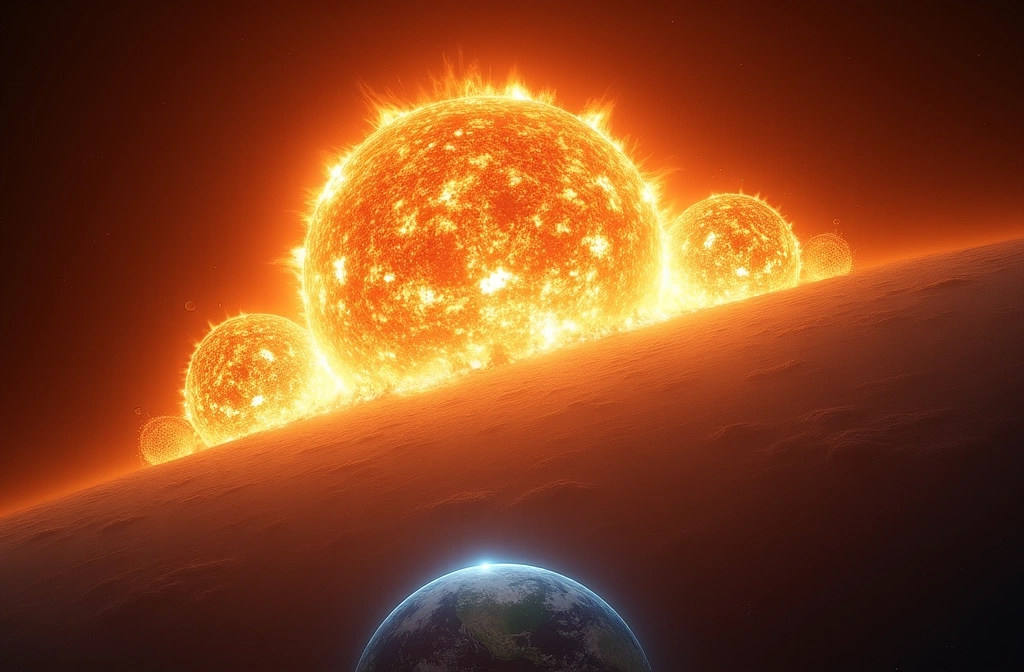
Multiple news outlets, including MSN, are reporting that triple solar flares have combined to form what space weather forecasters call a "cannibal CME"—a phenomenon where successive coronal mass ejections merge into a single, more energetic plasma wave. This merged event is now on a collision course with Earth's magnetosphere.
The National Weather Service has issued a G3 geomagnetic storm watch in response. On NOAA's 5-point geomagnetic storm scale (G1–G5), a G3 event is classified as "strong" and can produce measurable effects on critical infrastructure.
Historical precedent matters here: G3-level storms have previously triggered voltage swings in transformers, temporary disruption of HF radio propagation, and degradation of GPS accuracy—particularly in polar regions and higher latitudes. Satellite operators typically increase monitoring during G3 conditions due to increased atmospheric drag at orbital altitudes.
The merger of multiple flares into a single CME is significant because it concentrates more mass and energy into one event. A cannibal CME typically travels faster and carries stronger magnetic field characteristics than isolated flares, increasing the probability of geoeffective impact when it arrives.
At this stage, watch status means forecasters have detected the solar activity and are tracking the inbound CME, but the exact arrival window and final intensity remain subject to refinement as the event propagates. NOAA's Space Weather Prediction Center will update severity levels as observation data improves.
For infrastructure operators—utilities, telecom, aviation, and maritime—a G3 watch is a standard trigger for heightened situational awareness. Ground stations and command centers routinely implement precautionary protocols: managing transformer loading, verifying backup systems, and staging rapid-response teams. For individuals, a G3 event is not a life-safety emergency, but it can cause localized service disruptions, particularly in power-dependent systems and long-distance communications.
The next critical indicator: arrival time. Once the CME reaches Earth's bow shock (typically 1–2 million km upstream), real-time magnetometer data will confirm impact velocity and field orientation. A sharp southward turn in the interplanetary magnetic field (Bz) will drive stronger coupling to Earth's magnetosphere and could push the storm to G4 territory.
