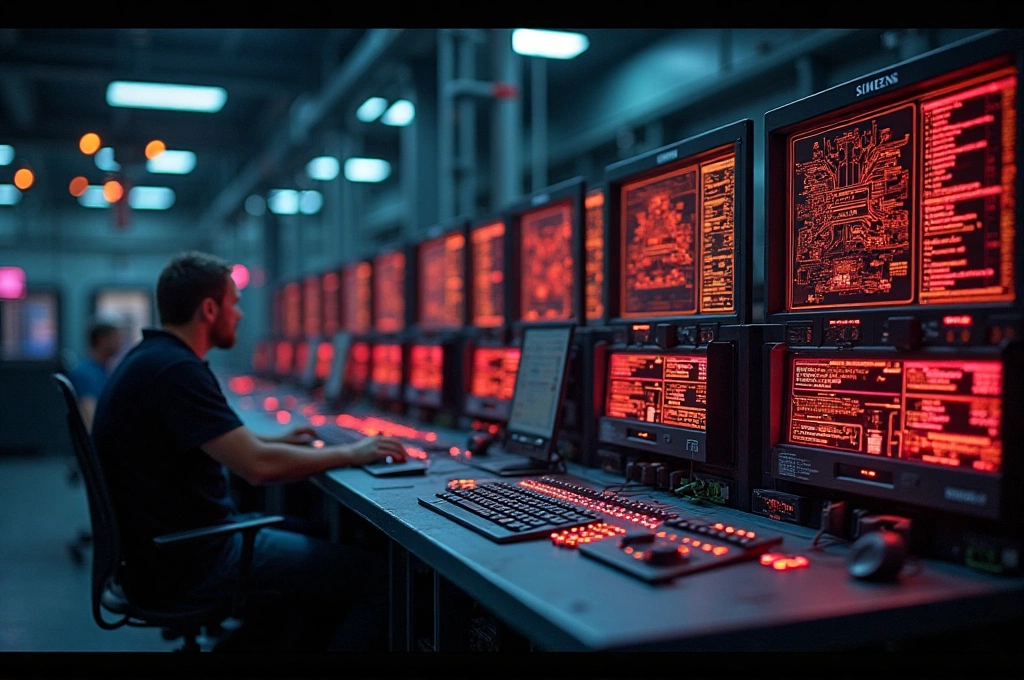
According to reports surfaced on August 21, 2026, the U.S. government issued a warning regarding active exploitation of Siemens S7 Series PLCs using AI-generated exploit scripts. These controllers are widely deployed across critical infrastructure sectors—power generation, water treatment, manufacturing, and petrochemical facilities.
The significance here is methodological. Siemens S7 controllers have long been targets for sophisticated state-level actors, but the use of AI-generated scripts suggests a lowering of the technical barrier to entry. Attackers no longer require deep reverse-engineering expertise to craft functional payloads; AI tools can generate working exploits from minimal input.
Why this matters: PLCs are not general-purpose computers. They run industrial processes—they don't reboot, they don't patch frequently, and downtime costs money. Compromise at the PLC level can result in physical process manipulation: altered pressure readings, valve position changes, or timing disruptions that cascade through interconnected systems. A water treatment facility hit by PLC compromise could theoretically alter chlorination levels. A power substation could experience relay misoperation.
The disguise element mentioned in the warning suggests attackers are embedding malicious payloads in what appears to be legitimate firmware updates or maintenance traffic—a social engineering vector layered on top of technical sophistication.
What to watch: Monitor your organization's network segmentation between IT and OT (operational technology) zones. Track any firmware update notifications from Siemens and your integrators. Look for anomalous communication patterns to/from PLCs—unexpected outbound traffic or irregular update schedules. If you operate or manage critical infrastructure, cross-check your S7 inventory against any published CVE lists tied to this campaign.
This is not theoretical risk. It is an active threat with demonstrated capability against specific, critical hardware. Preparedness here depends on visibility into what you're running and segregation of control systems from untrusted networks.
