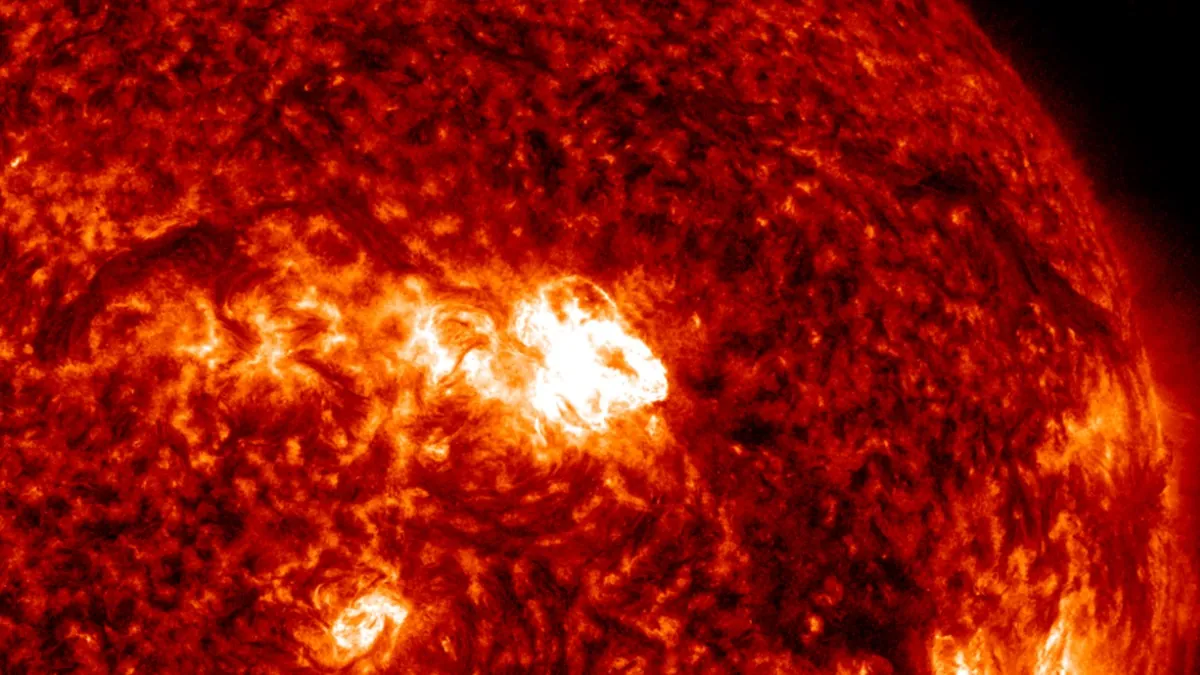
At 11:28 UTC on June 3, 2026, Active Region 4455 produced an X1.0 solar flare, according to reporting from The Watchers. The eruption generated R3 – Strong radio blackout conditions on the sunlit side of Earth, meaning high-frequency radio communications, particularly those used in aviation, maritime operations, and emergency services, faced degradation during peak impact hours.
X1.0 flares sit at the high end of the X-class spectrum—the strongest category. While not unprecedented, they represent the threshold where cascading effects begin to compound. R3 radio blackouts are strong enough to disrupt emergency frequency coordination, pose challenges for transatlantic aviation communications, and may affect amateur radio networks and certain GPS-dependent systems in real time.
What matters here: The source identifies Region 4455 as "geoeffective," meaning it's positioned to direct energy toward Earth. The flare has already landed. The question now is whether a coronal mass ejection (CME) follows and what its vector and speed might be. CMEs associated with X-class flares can trigger geomagnetic storms ranging from G1 (minor) to G5 (extreme), with significant implications for grid stability, transformer loading, and satellite operations.
For infrastructure-dependent systems—power grids, financial networks, GPS/navigation services—the risk window remains open. A G3 or higher geomagnetic storm could push transformer margins in aging grid infrastructure, particularly in higher latitudes. Real-time space weather monitoring and grid operator alerts are the immediate critical factors.
Historically, X1.0 flares without strong associated CMEs produce localized radio impacts but limited geomagnetic follow-on. However, the 1989 Quebec blackout was triggered by a G5 storm from a similar-magnitude event. The difference between contained impact and cascading failure often comes down to CME arrival speed, density, and magnetic orientation—variables that remain uncertain until arrival.
Monitor NOAA Space Weather Prediction Center updates for CME tracking data and geomagnetic storm watches. This event has moved from theoretical space weather risk to active disruption. Escalation indicators: upgraded geomagnetic storm watches, confirmed CME arrival data, or subsequent X-class flares from the same region within 48 hours.
