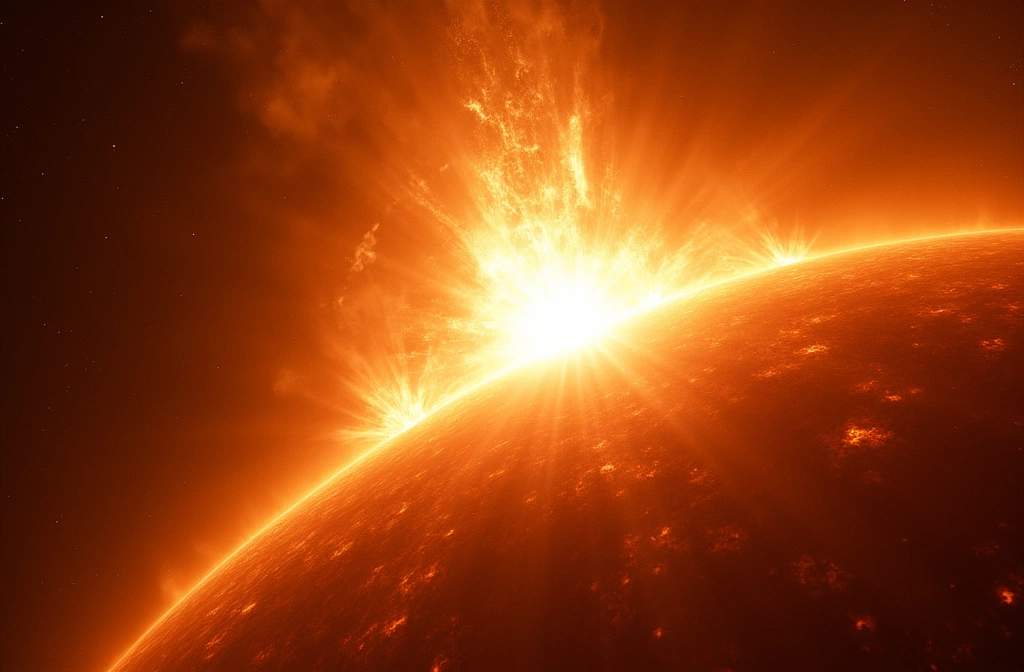
On July 6, 2026, Region 4482 on the sun's southeastern limb produced an X1.3 class solar flare — the highest-magnitude event in this recent cluster of activity. This follows an X1.1 flare that produced an Earth-directed coronal mass ejection (CME) with a G2 geomagnetic storm watch issued, and an M5.8 flare that triggered (and was subsequently canceled) a solar radiation storm warning.
X-class flares represent the most severe category on the solar flare scale. While individual events don't guarantee grid failure or widespread infrastructure damage, they do create conditions where induced currents in long transmission lines, transformer saturation, and GPS/communications disruptions become operationally relevant. A G2-level geomagnetic storm — the second tier on NOAA's 5-point scale — can degrade HF radio propagation, cause drift in GPS accuracy, and trigger voltage irregularities in power systems, particularly in high-latitude regions.
What distinguishes this event: the clustering. Three significant flares in rapid succession, from the same active region, demonstrates sustained solar instability. Region 4482's position on the SE limb means future eruptions from this region carry non-zero probability of Earth-directed CME propagation — the variable that matters most for terrestrial impact.
For grid operators and infrastructure managers, this is a yellow-flag moment. Geomagnetic storm watches trigger elevated protocols: closer monitoring of transformer health, voltage management adjustments, and communications redundancy checks. These are not emergency procedures — they are precautionary.
For preparedness-minded individuals: this is not a time for action, but for audit. Verify that backup power systems are functional, that critical medications and supplies are accessible without grid-dependent systems, and that communication plans don't rely solely on internet or cellular infrastructure. The probability of cascading failure from a G2 storm remains low — but sustained X-class activity raises the floor on what's possible.
The next 48-72 hours will indicate whether Region 4482 continues producing significant events or tapers. Solar activity is inherently unpredictable; monitoring official NOAA Space Weather Prediction Center alerts remains the only reliable real-time indicator.
