

Can You Listen to the Radio During an EMP? What Still Works


Quick answer
Short answer: probably yes. If it's a small battery or hand-crank radio that wasn't plugged in, it has a good chance. Here's which stations should stay on the air and how to store a radio.
In this guide
- “During” or “after”? And which kind of EMP?
- Why would a little radio survive?
- Which stations should still be on the air?
- How do you find your stations?
- What kind of radio should you buy?
- How do you store a radio for an EMP?
- What do you do in the first hours?
- Frequently asked questions
- Want your plan on paper?
- Sources
Last updated: November 16, 2026
When the power goes out, your phone gets less useful every hour. A small radio doesn’t need a tower, a router or a wall socket.
- The radio: the U.S. government’s EMP guide (CISA, 2019) says small electronics without cables are “relatively resilient to EMP”, and it tells organizations to “use battery operated AM/FM/NOAA radios to receive Emergency Alerts.”
- The stations: FEMA backs 77 AM stations built to stay on the air in a national emergency. A 2022 Department of Homeland Security report says they have EMP-protected shelters, backup communications and a generator.
So the plan has two parts: protect your radio, and know which stations to try first.
“During” or “after”? And which kind of EMP?
The pulse itself is over in less than a second. What people really want to know is whether the radio will work in the hours and days after.
It also depends on the cause:
| Nuclear EMP (high-altitude blast) | Solar storm | |
|---|---|---|
| Small battery radio | At some risk. Good storage helps. | Not harmed. |
| Power grid | Can fail over a wide area | Can fail over a wide area |
| Radio signals | Long-distance radio may be disrupted for a while | Shortwave can fade or black out for hours |
In both cases the grid is the weak point, not your pocket radio. That’s why a radio that runs without wall power matters. For more on the difference, see EMP vs solar flares vs nuclear.
Why would a little radio survive?
An EMP does most of its damage through long wires. CISA’s guide explains that “cables act as antennas to conduct EMP energy to unprotected equipment.” Power lines and long cables soak up the pulse and send it into whatever is plugged in.
A pocket radio running on batteries has no long wire attached.
Two things lower the odds:
- It’s plugged in or charging. CISA warns small devices “can be disrupted, particularly if they are turned on and/or charging when the EMP occurs.”
- A long antenna is attached. A long wire strung outside acts like a power line. A short built-in antenna is much safer.
We won’t pretend: nobody can promise any one radio will survive. There’s very little public test data on household radios. Good storage tips the odds your way.
What to do: keep your emergency radio unplugged, with the batteries out and the antenna folded.
Put this plan on paper
Print at home in US Letter or A4. One-time price, instant download.
Power Outage Bundle
What to do when the lights go out, a pantry that keeps your family fed, and a 12-month plan to get ready.…
$9.90 $11.70 for all 3

World War III Ready Binder
A calm, step-by-step plan for war threats, fallout and grid-down days at home. Every safety step is traced to Ready.gov, FEMA, CDC…
$14.90 one-time
Which stations should still be on the air?

| Band | Chance it’s on the air | Reach | Try it |
|---|---|---|---|
| AM | Best. FEMA’s protected stations are AM. | Far, and much farther at night | First |
| NOAA Weather | Fair. Needs power and a link to the Weather Service. | Local | Second |
| FM | Depends on each station’s generator | Local | Third |
| Shortwave | Stations far away may be untouched | Other regions and countries | When local bands are quiet |
AM: start here
FEMA calls its protected stations Primary Entry Point (PEP) stations. There are 77 of them. FEMA says they are “specially designed and hardened” and together “reach more than 90 percent of the U.S. population.” A national emergency message goes out on these stations first, and other stations pass it on.
The 2022 DHS report says FEMA ran high-altitude EMP tests on this equipment to check that the protection works.
AM also travels farther after dark. At night you may hear stations hundreds of miles away.
NOAA Weather Radio
NOAA has more than 1,000 transmitters. They all use one of seven channels: 162.400, 162.425, 162.450, 162.475, 162.500, 162.525 and 162.550 MHz. Most emergency radios have a “WX” button that steps through them.
FM and shortwave
FM covers a small area, and many stations have no generator. Shortwave can bring in stations from far outside the affected area. CISA notes that a high-altitude blast can disrupt long-distance radio for a time, so if you hear only static, try again later.
What to do: start with AM, then try the WX button for NOAA weather.
How do you find your stations?
FEMA doesn’t publish a simple list of the 77 stations for the public. Here’s the practical way:
- Search for your state’s “EAS plan” (Emergency Alert System plan). It names the main stations your area’s alerts come from.
- Tonight, after dark, tune slowly across the AM dial. Write down the strongest stations and where they’re from.
- Tape that list to the radio you’re going to store.
What kind of radio should you buy?
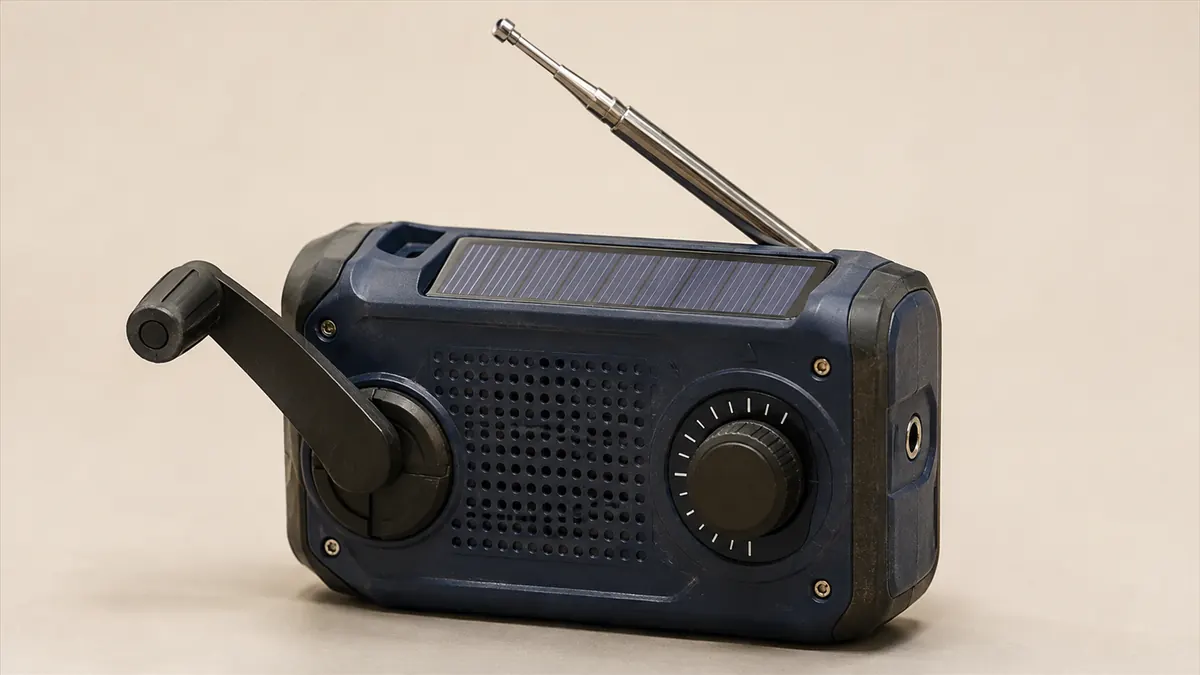
- AM, FM and NOAA weather bands. Shortwave is a bonus.
- Three ways to power it: replaceable batteries (AA or AAA), a hand crank and a small solar panel.
- A built-in or short folding antenna.
- Simple controls. A real tuning knob is easier in the dark than tiny buttons.
- A headphone jack, which makes the batteries last longer.
You don’t need an expensive one. A basic radio you’ve used a few times beats a fancy one still in its shrink-wrap.
How do you store a radio for an EMP?

- Take the batteries out so they can’t leak.
- Wrap it or box it. CISA suggests you “wrap spare electronics with aluminum foil or put in Faraday containers.” The simple home version: wrap the radio in a towel, then in several layers of heavy foil with no gaps, or put it in a metal can with a tight lid. Home methods like these aren’t lab tested, but they follow the same idea. Our Faraday cage guide goes deeper.
- Store spare batteries next to it, not inside it.
- Keep a second radio for everyday use. Practise with that one and leave the stored one alone.
- Check it twice a year. Put batteries in, make sure it plays, then wrap it again.
What do you do in the first hours?
- Unwrap the stored radio, put in batteries and start with AM.
- Write down every station you hear, and the time.
- Try again after dark.
- Save your batteries. Listen for a few minutes each hour, then turn it off.
- Don’t act on the first rumor. Wait until you hear the same message twice, or from two stations.
What to do: listen for a few minutes at the top of each hour, then switch off to save the batteries.
Frequently asked questions
Will a car radio work after an EMP?
It might, if the car still runs and the radio wasn’t damaged. A car has long wiring runs, so it carries more risk than a pocket radio. See our guide: Can You Protect Your Vehicle from an EMP?
Does a radio have to be in a Faraday cage?
No, but it improves the odds. Storing it unplugged, with the batteries out and no long antenna attached, already helps a lot.
What should I listen to first after an EMP?
The strongest AM stations in your area, then NOAA weather. Make your station list now, while the internet works.
Will my phone work after an EMP?
The phone itself may survive. But CISA points out that for small devices “their supporting infrastructures are not” resilient. Without towers and networks, a phone can’t call. A radio needs no network to receive.
Can I talk to anyone, or only listen?
A normal radio only listens. To talk you need two-way radios or a ham radio. Our ham radio guide explains how to start.
Want your plan on paper?
A radio tells you what’s happening. A written plan tells your family what to do next. Everything in this article is free and enough to start. If you’d like it printed and on the fridge, the Power Outage Bundle has the outage charts (fridge and freezer times, generator safety), the pantry system and a month-by-month prep plan in one download.
A phone needs a tower. A radio just needs batteries.
Sources
- CISA, Electromagnetic Pulse (EMP) Protection and Resilience Guidelines for Critical Infrastructure and Equipment, February 2019.
- FEMA, news release on Primary Entry Point stations, June 28, 2022 (77 stations; more than 90 percent of the U.S. population).
- Department of Homeland Security, report on protecting the National Public Warning System from EMP, September 2022, as reported by Nextgov.
- National Weather Service, NOAA Weather Radio (seven frequencies; more than 1,000 transmitters).


Comments
Comments appear right away. We remove spam, sales links and personal attacks.
No comments yet. Yours can be the first.