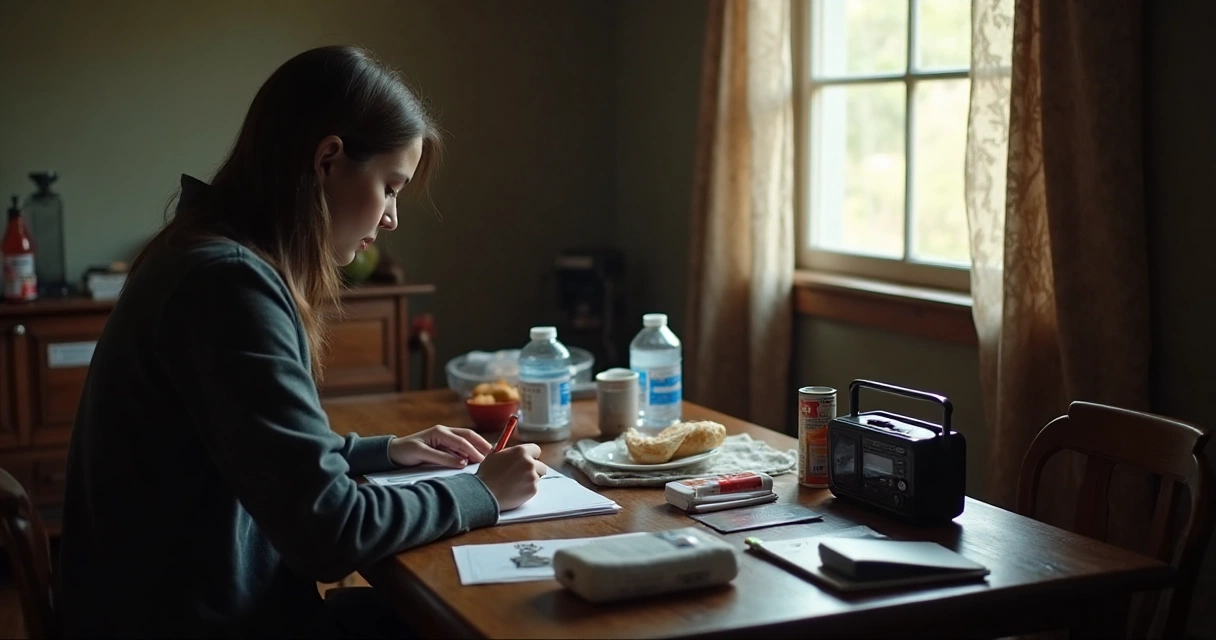
Most EMP response guides hand you a checklist and assume you're sitting calmly at home with your supplies staged, and your family accounted for. That assumption fails most people immediately. The first ten minutes after an electromagnetic pulse are not calm — they are a collision of dead electronics, stalled traffic, and the specific kind of confusion that comes when nothing behaves the way it's supposed to. What you do in those ten minutes, and the two hours that follow, determines whether your household stabilizes or spirals.
This isn't a long-term recovery guide. Long-term recovery from a full-grid EMP is a months-long problem with entirely different variables. What follows covers the immediate response window — the first 24 hours — organized into four operational phases with 14 specific steps. Each phase has a defined purpose. Each step has a "why," not just a "how." And where the standard advice breaks down in real conditions, I've flagged the failure points directly.
One prerequisite: these EMP survival steps assume you already have baseline supplies in place — water storage, a battery-powered or hand-crank radio, a first aid kit, and some food reserves. If that foundation isn't built yet, the final section of this article tells you exactly where to start before anything else.
Phase 1: Immediate Safety — Steps 1 Through 3
The first three steps happen in the first 10–15 minutes. Their purpose is singular: keep you alive long enough to think clearly. This is not the phase for resource management or information gathering. It is the phase for physical survival and location awareness.
Step 1: Assess your immediate environment. Before you move anywhere, pause and look. An EMP — particularly one from a high-altitude nuclear detonation — can cause electrical fires from surge-damaged wiring, disable traffic signals, and stall vehicles mid-intersection. If you're indoors, check for smoke, sparking outlets, or any sign of electrical fault. If you're in a vehicle, steer to the shoulder immediately — even if the engine is running. Newer vehicles with engine control units are more vulnerable to E1 pulse damage than older carbureted models; don't assume your car will keep running.
Step 2: Move to shelter. Your home is almost always the right destination — it's where your supplies are, where your family expects to find you, and where you have the most control over your environment. If you're more than a few miles out, the calculus changes (addressed below). If you're within walking distance, walk. A stalled car is not a shelter — it's an obstacle.
Step 3: Account for family members. This step fails without prior preparation. The single most important thing I tell every client who has children in school or a spouse with a different commute is this: your meeting point protocol must be practiced before the event, not improvised during it. Establish a primary meeting point (your home), a secondary (a neighbor's address), and a tertiary (a location outside your immediate neighborhood). Write it down. Put a laminated copy in every family member's bag.
What this means: If you haven't rehearsed your meeting point with your family, Step 3 will cost you time and clarity precisely when you can afford to lose neither. Run the drill once — it takes 20 minutes and changes everything.
Problem: You're 10 miles from home when the EMP hits. Don't attempt to drive if the vehicle won't start or traffic is gridlocked. Prioritize Steps 1 and 2 first — get safe, get off the road. Then execute Step 3 by reaching your predetermined rally point via the most direct walkable route. A 10-mile walk is a 3–4 hour problem, not a crisis, if your family knows where to wait.
Phase 2: Information Gathering — Steps 4 Through 6
Here's the part most guides miss: rushing to gather resources before you understand what you're dealing with is how people make irreversible decisions based on incomplete information. Phase 2 is about confirming the event type and establishing your information baseline — before you start burning through supplies or taking actions you can't undo.
Step 4: Determine whether this is actually an EMP. A widespread power outage can have many causes — transformer failure, cyberattack, severe weather, or grid overload. An EMP produces a specific signature: simultaneous failure of battery-powered devices, vehicles stalling across the board, and no AM/FM signal on analog receivers. If your hand-crank or battery-powered AM radio still receives a signal, the event may be a conventional outage. If analog devices are also dead, you're likely dealing with something significantly worse. This distinction changes every resource decision you make in the next 24 hours.
Step 5: Assess grid status without touching main power. Check your breaker panel visually — but don't start resetting breakers randomly. Test one battery-powered device at a time. If a device that was unplugged and stored survives, that confirms partial shielding. If everything fails regardless of power source, the E1 component was severe.
Step 6: Secure alternative communication. A hand-crank NOAA weather radio is your primary source of information when every digital channel is down. The Midland WR400 and similar units in the $30–$60 range receive NOAA All Hazards broadcasts on battery power alone. If you have a licensed amateur radio operator in your network, the 40-meter HF band (around 7 MHz) carries regional traffic well during grid-down conditions — the ARRL's recommended grid-down communication protocols are worth reviewing before you need them.
Bottom line: Your phone is dead. Your car won't start. Before concluding it's a full-scale EMP, check one analog AM radio. The answer to that single test changes your entire response priority.
Problem: Your phone is dead, and your car won't start — how do you confirm what's happening? The hierarchy is: (1) hand-crank or battery AM/FM radio — if it receives a signal, the event may be grid-only; (2) check a neighbor's older vehicle — pre-1980s carbureted engines have minimal electronics and are more likely to survive E1; (3) look for patterns — if streetlights, traffic signals, and all vehicles across multiple makes are simultaneously inoperative, treat it as a confirmed EMP event and proceed accordingly.
Phase 3: Resource Lockdown — Steps 7 Through 10
This is the highest-urgency resource phase. The window for some of these actions is measured in hours, not days. Miss it, and you won't get a second chance.
Step 7: Fill every water container immediately. Municipal water systems depend on electrically powered pumping stations. Most urban and suburban systems will lose pressure within hours of grid failure — some within 30–90 minutes depending on reservoir elevation and local infrastructure. Fill bathtubs using a WaterBOB or similar bathtub liner (roughly $30, holds up to 100 gallons), fill every pot, jug, and container in the house, and do it before you do anything else in this phase. This is non-negotiable. Once pressure drops, that option is gone.
Step 8: Manage food to prevent spoilage. A full, undisturbed refrigerator maintains a safe temperature for approximately four hours. A full freezer holds for 24–48 hours if sealed. The protocol is simple: do not open either until you have a consumption plan. Prioritize refrigerated items that will spoil fastest — dairy, raw meat, cooked leftovers. Move them to a cooler with ice if available. Frozen and shelf-stable items are your medium-term reserve — don't touch them until the perishables are consumed.
Step 9: Consolidate medical and sanitation supplies. Gather medications, first aid kit, sanitation supplies (hand sanitizer, waste bags, toilet paper), and any prescription items into a single accessible location. If a family member requires refrigerated medication — insulin being the most critical — address cold storage immediately using a cooler and any available ice. Document what you have and how long it will last at current consumption rates.
Step 10: Secure your home. As the hours pass after a major grid event, social behavior degrades in predictable patterns. Close and lock all ground-floor windows and entry points. Assess sight lines from the street. This isn't about assuming the worst from every neighbor — it's about reducing your household's visibility as a resource target before desperation sets in in the broader community.
Bottom line: Steps 7 and 8 have hard time limits. If you execute every other step correctly but miss the water-fill window, you've created a life-threatening deficit within 24 hours. Water first, always.
Problem: Power is out everywhere — how do you decide what food to use first? The sequence is perishables → refrigerated non-perishables → frozen (once thawed) → shelf-stable reserves. Never break into your long-term food storage while perishables are still safe to consume. That discipline extends your supply window by days.
Phase 4: Operational Readiness — Steps 11 Through 14
By the time you reach Phase 4, your immediate survival needs are addressed. Now you're building the operational structure that will determine whether you sustain that stability over the coming days and weeks.
Step 11: Establish a watch rotation. If your household has three or more adults, set up a rotating 4–6-hour watch schedule through the night. One person monitors conditions — sounds, approach of people or vehicles, fire risk — while others rest. Sleep debt is a decision-making liability you cannot afford by day two.
Step 12: Build your communication tree. Contact neighbors who are known to be prepared. Establish a check-in schedule — twice daily, at fixed times — using a predetermined signal (a knock pattern, a flag in a window, a hand-crank radio channel). If you have family outside the affected zone, designate an out-of-area contact who can relay messages. Amateur radio operators on your street or in your neighborhood can become a community information hub; the family communication plan templates at EMPSurvive.com include a neighbor coordination worksheet designed for exactly this scenario.
Step 13: Inventory and ration critical supplies. Count everything: gallons of water, days of food at estimated consumption rates, medication doses remaining, fuel in vehicles and generators, and battery reserves by device type. Divide totals by the number of people in your household. Assign daily rations now, not when supplies start running low. Rationing initiated under pressure is rationing done poorly.
Step 14: Document your home's condition. This step gets skipped almost universally, and it costs people later. Walk through your home and document visible damage — photographically if a camera survived, written notes if not. List high-value items and their location. This record supports insurance claims, recovery assistance applications, and helps establish what was lost versus what was consumed. Takes 20 minutes. Saves months of reconstruction later.
Problem: Limited supplies, multiple family members — how do you prioritize? Healthy, mobile adults receive maintenance rations. Children, elderly, and medically compromised members receive priority on nutrition and medication. Reduce your own consumption before reducing anyone else's — a capable adult managing logistics is a force multiplier for the whole household. This is a clinical calculation, not a moral one.
Critical Mistakes That Unravel All 14 Steps
Here's what most people get wrong about EMP response: the steps themselves aren't the hard part. Execution under stress is. These are the failure modes I see most consistently:
Waiting for official instructions. This isn't cynicism — it's infrastructure reality. In a full-grid EMP event, FEMA and local emergency management face the same communication blackout you do. Official guidance may take 48–72 hours to reach affected areas through any channel. Waiting for clearance before acting on your own behalf costs you the water-fill window, the food-preservation window, and the security-establishment window simultaneously.
Attempting to drive beyond 1–2 miles. Gridlocked roads with stalled vehicles become impassable within minutes of a widespread event. Fuel is finite and irreplaceable in the short term. Walking is underestimated as a primary mode of movement in the first 24 hours.
Opening refrigerators and freezers to "check" the status of food. Every time you open a door, you lose thermal retention. This isn't physics — it's physics. Sealed, undisturbed appliances extend food safety by hours. An opened refrigerator loses safe-zone temperature twice as fast.
Extending trust too quickly. In the first 12–24 hours, most people are genuinely confused and looking for information. By hour 36–48, resource desperation changes behavior. Establish your household security posture early, before you need it urgently.
How the 14 Steps Change Based on Your Situation
A linear checklist assumes identical conditions. Real EMP events don't cooperate with that assumption.
Urban vs. rural EMP response. Urban environments front-load Steps 1, 2, and 10 — the hazards of traffic gridlock, crowd panic, and security risk are acute and immediate. Rural responders have more time on Steps 1 and 10, but face longer distances to family members (Step 3) and potentially limited water alternatives if well pumps are electrically driven. A hand-pump or gravity-fed backup for your well is part of the 30-item EMP preparedness checklist for rural households specifically.
Day vs. night EMP. A nighttime event means family members are likely home — Step 3 is simplified. It also means darkness compounds every physical movement. A pre-staged flashlight and headlamp at each sleeping location is a baseline preparedness measure, not an advanced one. Daytime events scatter family across schools, workplaces, and commute routes — Step 3 becomes the critical path item, and the meeting-point protocol carries the most weight.
Seasonal variables. A winter EMP introduces cold exposure as a primary threat within hours — heating becomes a Phase 1 concern alongside shelter. A summer EMP makes food spoilage faster and heat exposure a medical risk, particularly for elderly family members. The electronic hardening and backup power planning that supports year-round climate management changes depending on which season you're mitigating.
Partial regional EMP vs. full continental collapse. A regional EMP — affecting one metro area or a few hundred miles — means outside assistance and information may arrive within 24–72 hours. A full continental EMP changes the timeline for external help from days to months, if it comes at all. This distinction matters for rationing calculations in Step 13. A regional event justifies consuming reserves more aggressively in expectation of resupply. A continental event demands severe conservation from hour one.
The Preparation Prerequisite: What Has to Exist Before These Steps Work
This isn't a section about motivation. It's a section about mechanics. Each of the 14 steps above requires that physical items be present in your home before the event. Here's the specific dependency chain:
Steps 4 and 6 require a hand-crank or battery-powered AM/FM/NOAA radio. If that device isn't already in your home — ideally stored in a basic Faraday enclosure — those steps cannot be executed. Steps 7 and 8 are dramatically more effective if you already have a WaterBOB, at least one cooler, and know where your shutoff valve is. Step 9 assumes a pre-assembled first aid kit and a current medication inventory. Step 11 assumes multiple adults, which you either have or don't, but it also assumes working flashlights, a procurement decision made weeks before the event.
If you're reading this before an event — which is the only useful time to read it — start with Steps 7 through 10 as your preparedness template. Water storage, food organization, medical consolidation, and home security hardening are the four pillars on which every subsequent step depends. Build those first. The rest follows.
The 14 steps are not the hard part. Having the supplies and practiced protocols to execute them under stress — that's where most households fall short. An EMP doesn't create the gap in your preparedness. It just reveals the one that was already there.